My secret love towards Spain apparently doesn't end with the language and tapas. Here comes Cava! It is one of the Spanish classics that is reliable and refreshing. It is mainly produced in Penedés (see the map below) and comes in 'good' price, which is shocking given that it is made using the same method as that used in the production of Champagne.
The key grapes used in the production of Cava are the local Macabeo, Parellada and Xarel-lo. At times, some producers add Chardonnay to add more rounded, modern notes.
AROMA AND FLAVOUR:
Cava is a dry, yet fresh companion that will entertain your evening with its apple notes and cheerful bubbles :) Dive in!
It all started in an innocent, somehow subtle manner. Yet, as an anonymous somebody once said “Wine improves with age. The older I get, the better I like it.” So having drunk a dollop of wine and being over a quarter of century (good vintage, right?) I finally had to succumb. I dare to call it a passion. I swear at the bad one and admire the good one, cause "[l]ife is to short to drink bad wine."
sobota, 10 stycznia 2015
środa, 31 grudnia 2014
Champagne (the finest sparkler)
Even if you don't know squat about wines, you must 'know' Champagne, know the pronunciation and know it comes from France (oh, does it?). Good, but not good enough.
Champagne is real Champagne only if it comes from the Champagne region in the North-east France. Sadly enough, many drinkers give the name to any sparkling wine, especially the ones bought for New Year's Eve celebrations, which - ironically - are often the cheapest fizz that have never even stood close to Champagne.
PRODUCTION AND GRAPE VARIETIES:
Its production takes heck of a lot time and it is very meticulous (I'm not going to bore anyone with it). The process called methode traditionelle has been adopted for other sparklers, too. Merci, France!
Only three grape varieties are allowed in Champagne, i.e., Chardonnay, Pinot Noir, and Pinot Meunier. You can also find variations: blanc de blancs made entirely from Chardonnay (creamy with yellow-fruit notes), and blanc de noirs made from Pinot Noir (aromatic with red-berry flavours).
VINTAGE OR NON-VINTAGE?
Pay attention to which Champagne you opt for! A bottle of non-vintage Champagne can be popped open right after release.
(http://www.sainsburys.co.uk/shop/gb/groceries/champagne/moët-et-chandon-demi-sec-nv-75cl)
However, the vintage fizz should be kept for a few years before you get down to business. Some supermarkets release vintage bottles after a few years of ageing already. You see how they make it easy on us?
(http://www.sainsburys.co.uk/shop/gb/groceries/champagne/lanson-gold-label--vintage-75cl)
AROMA AND FLAVOUR:
Champagne is a truly powerful wine, filled with rich fruit and creaminess, notes of bread and chocolate. It should be perfectly balanced, rich and complex yet with high acidity, a lot of crispiness and bubbles that will go with many dishes. You can enjoy Champagne young or aged (it depends on Champagne). The latter will reveal honeyed, toffee notes.
LEVELS OF SWEETNESS:
Brut = dry; goes well with fish, poultry, cheese
Sec = slightly sweeter than brut; goes well with savoury dishes, seafood, pâté
Demi-sec = sweeter than sec, with honeyed notes, goes well with dessert dishes (not too sweet, though!), sweet-tasting dishes, e.e.g, Thai food
Voilà!
MAKE IT WORTHWILE :)
Do you still wonder why Champagne is the most adored fizz around the globe?
Needles to say, the prices can stress your wallet. Here come the last pieceS of advice.
Do not go for the cheapest Champagne(!), unless you are already so wasted that you will not even draw the difference between high quality and the lowest quality. But seriously preaching, don't! :)
Serve it chilled and drink up soon after opening not to let it go flat. Is there anyone who actually needs to be told to drink Champagne up? ;)
And once you see the bubbles are tiny and there are plenty of them - you know you hit a good bottle!
sobota, 22 listopada 2014
Viognier (perfumed and full-bodied)
AROMAS AND FLAVOURS:
If it's perfumed peaches, apricots and honeysuckle you crave, Viognier is the best pick for you. The important thing is that grapes must come from low-yielding vines, as this is when grapes have more concentrated flavours. Sadly enough, many growers look to sell more wine, and we know what that means :(
BEST REGIONS:
*FRANCE, the Rhone Valley (Condrieu)
If you don't want to get disappointed and a bottle of diluted wine is the last thing you want on Saturday evening, Condrieu is the region you want to opt for (see the map below):
However, the price may repel many. For the ones who like their wallet content too much, the solution lures in the Languedoc, where cheaper, but less concentrated Viognier is produced:
*THE U.S., Colombia Valley
You can expect wines with firm and crisp acidity. Nothing to complain about y'all :)
niedziela, 9 listopada 2014
Semillon (chameleon wine)
If what you want in wine is full flavour, but you have had enough of omnipresent Chardonnay, then look no further! Sémillon will offer you pretty much everything you ask for. And I mean it! It can produce lean dry, rich dry or sweet wine!
AROMA AND FLAVOUR:
I) Young Sémillon wines taste lean and grassy and they are packed with plenty of lime, which gives it the character, lemon and honey. It almost sounds like a perfect cough medicine ;)
http://www.laithwaites.co.uk/product/28775
II) As the wine grows older it gets more rich, smokey and toasty.
http://www.colvinwines.com.au/semillon-wines
III) The grape also makes for good sweet peachy wines - its thin skin makes the fruit vulnerable to botrytis (a mould that plays a crucial role in production of sweet wines).
BEST REGIONS:
* Australia - the Hunter Valley, the Barossa Valey, and the Clare Valley
It is the land of exceptionally good Sémillon wines. This is where you are going to meet the ripest bottles. Well, the rest was already said above.
CURIOSITY KILLED THE CAT:
In France, Sémillon is often blended with Sauvignon Blanc to add extra flavour, or maybe to 'dilute' the wine a bit. This is often done in the production of both dry and sweet wines.
piątek, 17 października 2014
Chardonnay (rich and powerful)
For some fans this is the only white wine that exists in this world. The rest are leftovers :P
Well, blind love... I kind of understand it.
But in generally Chardonnay is an easy grape to fall in love with as is it very easy to work with. It produces good wines even if it's at its worst. Ir can be grown on in any country to produce any type of wine: oaky, fresh, fruity, sparkling. Any, any, any. Kind of a slut... :) But in the wicked world we live in, it is all we want.
BEST REGIONS:
* FRANCE - Burgundy
Just as some may say that Chardonnay is the queen of white wines, others (or actually the same group) may say the Burgundy is its home. If you get white wine from Burgundy, you may be 99% sure you are getting Chardonnay (even though you will not see that on the label):
http://www.laithwaites.co.uk/product/28976
The prime location will be Cote d'Or (see the map below). Give in and you will discover wine that is concentrated yet well-balanced, oaky yet fresh, honeyed yet dry. Be careful with bottles coming from Maconnais (see the map) as they may taste thin and uninteresting.
I am afraid that in the case of Chardonnay you will have to spend much more on a bottle, especially if you want to impress your date (unless she knows squat about wines). Why is that? The best vineyards marked as grands crus can only produced limited amount of wine and the demand is great... you do the calculations :)
Chablis, to the north of the Burgundy, is known for its lighter type of Chardonnay which results from cooler vineyards. It tastes more crispy with noticeable mineral notes thanks to the soils that are rich in chalk and clay. Beware! This type of Chardonnay is often unoaked. This is why - in its style - it's closer to spicy, fruity wines. And it is extra fruity with tons of oranges, apples, and rhubarb:
However, if light Chardonnay sounds to you as crazy as beef steak for breakfast and Polish wedding with no vodka, you should leave Burgundy and make your way to the far south of France, i.e. Languedoc. It is there where you are going to find the richest, oakiest, creamiest, ...est, ...est, ...est Chardonnay. It will be often labelled Vins de Pays d'Oc. It tastes super ripe and buttery:
*AUSTRALIA
The second most famous country producing Chardonnay wines. Its warm vineyards In Hunter and Barossa Valleys give birth to riper and more concentrated type of Chardonnay, which I personally adore. You are almost knocked over with the amount of spices, vanilla notes and all the resin from the oak barrels you can smell:
Well, but Aussies know that there are many demands to meet, so recently they started producing crisper - let's say - elegant wines. Those can be found in cooler climate regions such as Clare Valley, Adelaide Hills, Tasmania (see the map below):
Australia is pretty well-known for its blends of Sémillon with the Chardonnay grape:
It will be heck of a lot crisper than Miss Chardonnay on her own, which maybe what one is looking for. Judging by how many Chardonnay-Sémillon you can find on the shop shelves, I reckon it is a quite successful blend, kind of like a good marriage, where the man (Sémillon) calms down the woman (Chardonnay) :)
Albariño (Olé!)
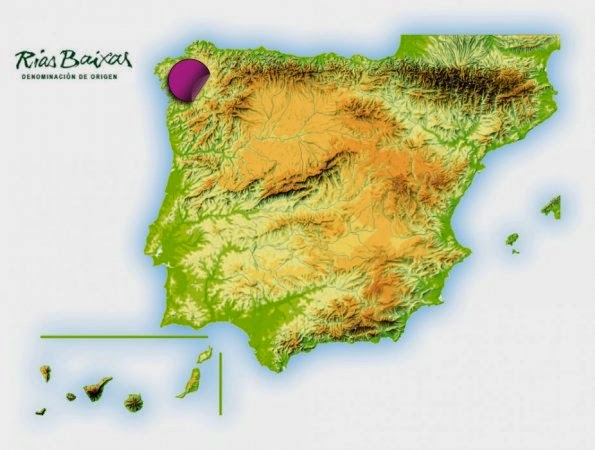
Spain is famous for its Rioja, and probably not many gives a f*** about its white wines. Let's break the habit and make mention of Albarino.
AROMA AND FLAVOUR:
This sun-kissed wine (how else could it be in such a hot country?), that comes from Rias Baixas (a region in Galicia), is filled with succulent oranges and lime, which is pretty much what you would expect from a Spanish bottle. It is pretty balanced as well - its weight combined with acidity ensures Flamenco will sound far better :)
(http://www.laithwaites.co.uk/product/Sendero-des-Santos-Albari%F1o-2012/29502?_requestid=743737)
Pinot Blanc (everybody's friend)
Wines from this grape are very soft and easy to drink. You have just found a reliable friend to watch "Titanic" with ;) The best come from Alsace, France.
AROMA AND FLAVOUR:
Mainly fruity with apples in front. At times gets creamy and you can feel bit of almond.
(http://alsace.uvinum.co.uk/hugel-et-fils-pinot-blanc-hugel-alsace-2010?utm_source=Google%2BMerchant&utm_medium=web&utm_campaign=marketplaces&gaw=1&gclid=CjwKEAiAvvyiBRDzrYuuldy6wB8SJABPJWOb-OizmJQkWe8i0GEd1fbPKgU4drkTjwYtTCpfdujhSRoCcXPw_wcB)
That was quick :)
Subskrybuj:
Posty (Atom)